

There’s no other city quite like Manaus. A sprawling metropolis of over 2.6 million people sitting in the heart of the Amazon rainforest, surrounded by thousands of kilometers of jungle in every direction, no road connects it to the rest of Brazil. It’s remote, unexpected, and utterly unlike anywhere else on Earth. And that’s precisely why it’s worth going.
Manaus is the gateway to the Amazon Rainforest, the starting point for river cruises, jungle lodges, wildlife expeditions, and encounters with indigenous communities that will stay with you for the rest of your life. But it’s also a fascinating city in its own right, with a jaw-dropping opera house, a rich history tied to the rubber boom, vibrant markets, and a food culture that reflects the extraordinary biodiversity of the region.
This guide covers everything international travelers need to know about visiting Manaus: where it is, how to get there, what to do, how to stay safe, when to go, and how to make the most of your time in one of the world’s most extraordinary destinations.
🧳 Plan your trip to Brazil
🏨 Hotels: Browse the best hotels on Booking.com
🎟️ Tours & activities: Find tours on Civitatis ·
🚗 Car rental: Compare prices on Rentcars
🛡️ Travel insurance: Get a quote here
Where is Manaus? Understanding the city and its setting
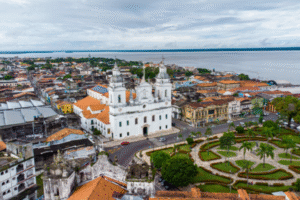
So, where is Manaus exactly? Manaus is the capital of the state of Amazonas, in northern Brazil. It’s located at the confluence of the Rio Negro and the Solimões River, the two major tributaries that together form the Amazon River. The city sits roughly 1,500 km from the Atlantic Ocean, making it one of the largest inland port cities in the world.
Manaus, Amazonas, is entirely surrounded by rainforest. There are no major highways connecting it to São Paulo, Rio de Janeiro, or other Brazilian cities. The jungle simply doesn’t allow it. This geographic isolation is part of what makes Manaus so fascinating, and so different from anything most international travelers have experienced before.
The state of Amazonas itself is enormous: it’s the largest state in Brazil and covers an area roughly the size of Western Europe. The Amazon Rainforest, which spans multiple countries, is anchored in this region. When you come to Manaus, you’re not just visiting a city, you’re arriving at the edge of the world’s largest and most biodiverse ecosystem.
For a broader look at traveling through northern Brazil, see our North Brazil travel guide.
A brief history of Manaus: From jungle fort to Amazon metropolis
Understanding where Manaus came from makes the city far more interesting to visit. The story is genuinely dramatic.
Manaus was founded in 1669 as a Portuguese colonial fort called Fort of São José do Rio Negro. The name “Manaus” itself comes from the Manaos indigenous people, and means “Mother of Gods” in their language. For its first two centuries, it remained a modest settlement in an impossibly remote jungle.
Then came rubber, and everything changed.
Between roughly 1890 and 1920, Manaus experienced one of the most spectacular economic booms in South American history, fueled entirely by the global demand for rubber. The rubber barons who controlled the trade amassed extraordinary wealth, and they spent it, on European architecture, imported marble, chandeliers from Paris, and most famously, on an opera house that still stands today as one of the most improbable buildings in the world.
The rubber boom collapsed when rubber plantations in Southeast Asia began undercutting Brazilian prices. Manaus fell into decades of economic decline, its grand buildings slowly being reclaimed by tropical humidity and neglect.
The city’s modern revival came in 1967, when Manaus was declared a Zona Franca (duty-free zone), which attracted electronics manufacturers and transformed it into an industrial and economic hub. Today, Manaus is a major city with a rapidly growing population and a thriving tourism sector centered on the Amazon.

Top things to do in Manaus
Manaus offers a remarkable range of experiences, both within the city itself and in the Amazon that surrounds it. Here’s what you shouldn’t miss.
Teatro Amazonas, The Opera House in the jungle
Nothing prepares you for the Teatro Amazonas (Amazon Theatre). Built at the height of the rubber boom and completed in 1896, this stunning Belle Époque opera house features a dome covered in tiles painted in the colors of the Brazilian flag, a stage imported from Europe, and an interior decorated with paintings, Venetian glass, and Italian marble. It took 15 years to build, with virtually all materials shipped from Europe.
That it exists at all, in the middle of the Amazon rainforest, is almost incomprehensible. Guided tours run daily and are strongly recommended for any first-time visitor. The theater still hosts opera, ballet, and other performances throughout the year.

The meeting of waters (Encontro das Águas)
One of Brazil’s most famous natural phenomena and an essential experience when visiting Manaus. The Meeting of Waters is where the dark, tea-colored Rio Negro flows alongside the sandy-brown Solimões River for several kilometers without mixing, the two rivers run side by side in visually distinct bands due to differences in temperature, flow speed, density, and acidity. It’s one of those things that sounds impossible until you see it with your own eyes.
The phenomenon occurs about 10 km east of Manaus and is accessible only by boat. Virtually every tour operator in Manaus offers half-day excursions to the Meeting of Waters, often combined with other activities like visiting floating communities or wildlife watching.
Book a Meeting of Waters day trip from Manaus with Civitatis, tours include English-speaking guides, hotel pickup, and boat transport.

Amazon jungle tours and river expeditions
This is what most international visitors come to Manaus for, and it doesn’t disappoint. The Amazon surrounding Manaus is a living, breathing, overwhelming ecosystem, and there are expedition options for every type of traveler.
Day trips are ideal if you have limited time. A well-organized Amazon day tour typically includes a speedboat ride on the Rio Negro, a jungle hike with a guide who explains medicinal plants and local survival techniques, wildlife watching (look for monkeys, sloths, caimans, and tropical birds), a visit to a riverside indigenous community, piranha fishing, and the chance to swim with pink river dolphins (boto vermelhos), one of the most unforgettable experiences available anywhere in Brazil.
Multi-day tours take you deeper into the jungle, typically staying overnight at a jungle lodge or at a local family’s home. These give you the chance to experience the Amazon after dark, when the forest truly comes alive, and to absorb the rhythm of life on the river.
Civitatis offers a range of well-reviewed options:
- Amazon Jungle Day Trip, swim with pink dolphins, hike in the rainforest, spot caimans at night
- 2-Day Amazon Tour, overnight in an Amazonian village with a local family, plus Meeting of Waters
- 3-Day Amazon Jungle Tour, deeper immersion, aircon lodge accommodation, all meals included
- Amazon River Safari, 7-hour boat safari covering the Meeting of Waters, pink dolphins, indigenous communities, and a buffet lunch
All tours include English-speaking guides.
Bosque da Ciência (Science Forest)
Managed by INPA, Brazil’s National Institute for Amazonian Research, Bosque da Ciência is an open-air park where you can encounter free-roaming Amazon wildlife in a conservation setting. Giant river otters, manatees, native monkeys, and dozens of bird species inhabit the 13-hectare reserve, which also serves as an active research center. Guided tours provide context on the region’s biodiversity and conservation challenges. This is one of the best options in the city itself for wildlife encounters without leaving Manaus.
Mercado Municipal Adolpho Lisboa
Built in 1882 and modeled on the iron-and-glass market halls of Europe, the Municipal Market of Manaus is one of the most atmospheric spaces in the city. It’s divided into three sections: fish, fruit and vegetables, and a general market. The fish section alone is extraordinary, enormous Amazonian species you’ve probably never seen before, displayed alongside more familiar catches. It’s noisy, vivid, fragrant, and deeply local. Come early in the morning for the best experience.
Museu do Seringal Vila Paraíso (Rubber Plantation Museum)
Located just outside Manaus on the banks of the Rio Negro, this open-air museum recreates a rubber plantation from the early 20th century, giving visitors a tangible sense of what the rubber boom actually looked like at ground level. The recreated manager’s mansion, worker housing, and processing equipment paint a vivid picture of one of the most economically transformative, and deeply exploitative, periods in Amazon history.
MUSA, Museu da Amazônia
Set within the vast Adolpho Ducke Forest Reserve on the outskirts of Manaus, the Museum of the Amazon offers immersive access to 100 hectares of primary rainforest, including a spectacular 42-meter observation tower that rises above the forest canopy. From the top, you look out over an unbroken sea of green stretching to the horizon. It’s one of the best viewpoints in the entire Amazon region.
Book a guided tour of MUSA with Civitatis, tours include guided walks through the reserve and forest canopy access.
Ponta Negra beach
Counterintuitively, one of Manaus’s most popular local hangouts is a freshwater river beach on the banks of the Rio Negro. Ponta Negra is a vibrant, family-friendly spot with a long promenade, food stalls, restaurants, and bars. The beach itself expands dramatically during the dry season when river levels drop, making it one of the city’s most lively social spaces. Watching the sunset over the Rio Negro from Ponta Negra is genuinely beautiful.
Presidente Figueiredo waterfalls
About 107 km north of Manaus, the area around Presidente Figueiredo is home to more than 100 waterfalls, many accessible via short trails through the Atlantic Forest. It’s a popular day trip from the city, especially during the dry season when water levels are clearer. Several of the falls have natural swimming pools.
Book a day trip to Presidente Figueiredo waterfalls with Civitatis, includes transport and a guide.
Anavilhanas archipelago
One of the world’s largest river archipelagos, Anavilhanas sits about 60 km upstream from Manaus on the Rio Negro and contains hundreds of forested islands. During the dry season, white sand beaches emerge between the islands. During the wet season, the forest floods and you can paddle through the treetops by canoe. Either version is spectacular.
Book an Amazon Jungle and Anavilhanas Islands tour with Civitatis, includes boat transport, a jungle hike, and a canoe ride.
Getting to Manaus: flights, boats, and logistics
By air
Eduardo Gomes International Airport (MAO) is the main entry point for international visitors. There are no direct flights from Europe or North America to Manaus, you’ll connect in São Paulo (GRU or VCP), Rio de Janeiro (GIG), Bogotá, Panama City, or Curaçao. From São Paulo, the flight to Manaus takes approximately 3.5 to 4 hours. Major Brazilian carriers including Latam, GOL, and Azul operate frequent connections.
Manaus is over 2,700 km from São Paulo and Rio de Janeiro, there is simply no practical alternative to flying for most international travelers.
By boat
For the adventurous, it’s possible to reach Manaus by river boat from Belém (on the Atlantic coast), a journey that takes approximately 5 days on a traditional Amazon river vessel. You sleep in a hammock on the open deck, watching the jungle slide past. It’s a remarkable experience, though not for those with schedule constraints. Boats also connect Manaus to Porto Velho and (with connections) to Iquitos in Peru and Tabatinga on the Colombian border.
Civitatis also offers a 5-day Amazon River cruise from Manaus to Belém, a scenic journey through riverside communities and jungle landscapes.

Getting around Manaus
Within the city, public buses are the most common option but can be crowded and confusing for visitors. Uber operates in Manaus and is widely recommended for tourists, it’s reliable, safe, and affordable. Traditional taxis are also available.
For exploring the region more independently, particularly for day trips to Presidente Figueiredo or the Anavilhanas, renting a car gives you significantly more flexibility. Rental agencies operate at the airport and in the city center. Rentcars.com lets you compare rates from multiple suppliers in Manaus at once, ensuring you get the best available price.
Where to stay in Manaus
The best areas for tourists to stay are Adrianópolis (upscale, quieter, close to restaurants and shopping malls) and the historic center (convenient for walking to Teatro Amazonas and the Municipal Market, livelier but requires more caution at night).
Luxury options in Manaus include Juma Ópera Hotel (historic boutique hotel directly facing Teatro Amazonas) and Blue Tree Premium Manaus (modern business-class hotel in Adrianópolis with a pool).
Mid-range travelers have strong options at Hotel Villa Amazônia, Ibis Styles Manaus, Ramada by Wyndham Manaus Torres Center, and the Intercity in Adrianópolis.
Budget travelers will find hostels and guesthouses near the historic center, as well as Ibis Budget properties.
One important note: if you’re booking Amazon jungle tours that include hotel pickup, check which hotels the tour operator services, some tours only pick up from hotels in specific neighborhoods. Civitatis tours in Manaus generally cover hotels in the historic center and Adrianópolis, plus the airport hotel area.
When to visit Manaus: dry season vs. wet Season
Manaus is a year-round destination, but the season you choose significantly affects your experience.
Dry season (june to november)
This is the most popular time for tourists and generally considered the best time to visit Manaus. River levels drop, exposing beaches along the Rio Negro (including the spectacular Ponta Negra and the Anavilhanas beaches). The jungle is more accessible on foot, heat is slightly more bearable (though still intense), and wildlife concentrates around remaining water sources, making sightings more likely. The Meeting of Waters is visually even more dramatic during the dry season.
Wet season (december to may)
The flooded season has its own extraordinary appeal. Water levels in the Rio Negro can rise by 10 to 15 meters, transforming the landscape entirely. The forest floods, known locally as the igapó, creating a submerged world that you navigate by canoe between the treetops. Pink river dolphins move deeper into the flooded forest and are often easier to approach. It’s less convenient logistically but offers a genuinely different Amazon experience.
Temperatures in Manaus are consistently high year-round, averaging around 27–33°C (80–91°F), with humidity that rarely drops below 80%. Come prepared for the heat regardless of season.
Is Manaus safe? Honest tips for international travelers
This is one of the most common questions about visiting Manaus, and the honest answer is: Manaus is a large Brazilian city that requires the same level of awareness and common sense as any major urban destination. It is not a place to wander carelessly, but it is absolutely a safe and worthwhile destination for prepared travelers.
The safest areas for tourists are Adrianópolis, Ponta Negra, and the historic center during daytime hours. These neighborhoods are where most hotels, restaurants, and tourist attractions are located.
Here are the most important safety tips for visiting Manaus:
In the city:
- Use Uber rather than hailing random taxis on the street
- Don’t display smartphones, cameras, or expensive jewelry in public spaces
- Visit banks and ATMs during the day, ideally inside shopping malls
- Carry only the cash you need for the day, keep the rest secure at your accommodation
- Avoid less-known areas and peripheral neighborhoods, especially at night
- Stay aware of your surroundings in markets and busy public spaces
In the Amazon:
- Always use a licensed, professional tour operator for jungle expeditions
- Never venture into the rainforest alone or without a guide
- Follow your guide’s instructions at all times, they know the environment
- When visiting indigenous communities, ask before taking photos and follow etiquette guidance from your guide
Health and vaccines:
- Yellow fever vaccination is strongly recommended for anyone visiting the Amazon region, and may be required by neighboring countries (Bolivia, Colombia, Peru) if you’re continuing your trip
- Consult your doctor about malaria prophylaxis, Manaus itself and most nearby tourist areas have low malaria risk, but more remote jungle areas carry higher risk
- Use insect repellent consistently, especially at dusk and dawn
- Drink only bottled or filtered water
- Stay hydrated, the heat and humidity are intense
Travel insurance is non-negotiable. Medical care can be expensive for uninsured foreigners in Brazil, and jungle activities, however well-organized, carry inherent risks. SafetyWing offers flexible, affordable international travel insurance starting at around USD $42/month, covering medical emergencies, hospital stays, and a wide range of adventure activities. We use and recommend it for any trip to Brazil, and especially for Amazon expeditions.

Food in Manaus: what to eat and where
The cuisine of Manaus and the Amazon is one of the most distinctive in Brazil, a reflection of indigenous traditions, river life, and the extraordinary biodiversity of the region.
Tacacá is perhaps the most iconic Amazonian dish: a hot soup made with jambu leaves (which cause a mild, pleasant tingling sensation in the mouth), tucupi (fermented manioc broth), dried shrimp, and fresh peppers. It’s served by street vendors in traditional gourds and is a genuine ritual for locals.
Pirarucu is the Amazon’s iconic freshwater fish, one of the largest freshwater fish in the world, and appears on menus throughout Manaus. Look for it grilled, fried, or in a moqueca-style preparation.
Açaí in Manaus tastes nothing like the sweetened, processed version common in international markets. Here it’s served as a thick, earthy, savory puree, often eaten with fish and manioc flour.
Caldeirada de Tucunaré is a flavorful river fish stew that represents caiçara-style Amazonian cooking at its best.
For restaurants, the historic center and Adrianópolis neighborhoods offer the best variety. The Municipal Market is the best place for fresh Amazonian produce, fish, and local snacks.
Practical information for international visitors
Getting there
- Airport: Eduardo Gomes International Airport (MAO)
- Connections: Via São Paulo (GRU/VCP), Rio de Janeiro (GIG), Bogotá, Panama City
- Flight time from São Paulo: ~3.5–4 hours
Getting around
- Within the city: Uber (recommended), taxis, public buses
- Day trips and regional exploration: Rental car (compare rates on Rentcars.com), or book organized tours
Money and costs
- Currency: Brazilian Real (BRL)
- Budget travelers: USD $50–70/day (hostel, local food, public transport)
- Mid-range: USD $100–150/day (hotel, restaurants, tours)
- Credit cards are widely accepted in hotels and larger restaurants; carry cash for markets and smaller vendors
- ATMs: Available at the airport and in shopping malls, use during business hours for safety
Visas and entry
- Citizens of the USA, Canada, EU, UK, and Australia can currently enter Brazil visa-free for tourism for up to 90 days, but always verify current requirements before traveling, as policies can change
- A valid passport is required; yellow fever vaccination certificate may be requested at entry from certain countries
Language
- Portuguese is the official language of Brazil, and English is not widely spoken in Manaus outside of major hotels and tour operators
- Learning a few basic Portuguese phrases goes a long way, locals genuinely appreciate the effort
- Tour operators recommended in this guide offer English-speaking guides
Climate
- Hot and humid year-round; average daily temperatures 27–33°C (80–91°F)
- Pack lightweight, breathable clothing; long sleeves for mosquito protection at dusk
- Sunscreen, insect repellent, and a refillable water bottle are essentials
How many days do you need in Manaus?
Here’s a rough guide:
1–2 days: Enough to see the Teatro Amazonas, the Municipal Market, Bosque da Ciência, Ponta Negra beach, and the Meeting of Waters on a half-day boat tour. Good for travelers with tight schedules.
3–4 days: The sweet spot for most visitors. Allows time for city exploration plus a 2-day jungle tour, giving you a real taste of the Amazon.
5–7 days: The ideal length for a deeper experience, combine the city with a multi-day jungle expedition, a day trip to Presidente Figueiredo or Anavilhanas, and time to explore at a relaxed pace.
If visiting the Amazon is your primary goal, plan at least 2 dedicated days in the jungle beyond your time in the city.
Amazon trips from Manaus: How to choose the right tour
The Amazon tour market in Manaus ranges from outstanding to mediocre, and choosing well makes an enormous difference to your experience. Here’s what to look for:
- Licensed, professional operators with verifiable reviews
- English-speaking guides (confirm this before booking)
- Small group sizes, the smaller the group, the better the wildlife encounter opportunities
- Ethical practices toward wildlife and indigenous communities, tours that prioritize observation over interaction, and that engage communities with respect
Civitatis offers a curated selection of Manaus and Amazon tours, all with English-speaking guides, verified operators, and free cancellation in most cases.
Essential Links for Your Manaus Trip
→ Browse all Manaus and Amazon tours on Civitatis, Meeting of Waters, jungle day trips, multi-day expeditions, night alligator tours, and more
→ Compare car rental rates in Manaus on Rentcars.com, essential for day trips to Presidente Figueiredo and other regional destinations
→ Get travel insurance from SafetyWing before you go, flexible coverage for international travelers, starting at ~USD $42/month, including adventure activities
Keep Exploring Brazil’s Amazon and North Region
Frequently Asked Questions about Manaus
Where is Manaus located? Manaus is the capital of the state of Amazonas, in northern Brazil, situated at the confluence of the Rio Negro and the Solimões River in the heart of the Amazon Rainforest.
Is Manaus safe for tourists? Manaus requires the same awareness as any large Brazilian city. Stick to tourist areas (Adrianópolis, the historic center, Ponta Negra), use Uber, don’t display valuables, and book jungle tours with licensed operators. The vast majority of international visitors have a safe and memorable experience.
What is Manaus famous for? Manaus is famous for the Teatro Amazonas opera house, the Meeting of Waters natural phenomenon, and its role as the main gateway to the Amazon Rainforest. It’s also known for its duty-free zone and as an economic hub in northern Brazil.
What is the best time to visit Manaus? The dry season (June to November) is generally the best time, beaches emerge, hiking is easier, and the Meeting of Waters is at its most dramatic. The wet season (December to May) offers a flooded forest experience by canoe that is equally spectacular, just different.
How do I get to Manaus? Almost all international visitors fly in, the Eduardo Gomes International Airport (MAO) receives connections from São Paulo, Rio de Janeiro, and international hubs. There are no connecting roads to Manaus from other major Brazilian cities.
How many days should I spend in Manaus? Minimum 2 days for the city highlights; 3–5 days to include a meaningful Amazon jungle experience. A week gives you a comfortable, unhurried itinerary.
Disclosure: This article contains affiliate links. If you book through our links, we may earn a small commission at no extra cost to you. We only recommend services we genuinely trust.

![Lee más sobre el artículo Brazil Amazon trip: everything you need to know [+ itineraries]](https://doinbrazil.com/wp-content/uploads/2025/07/palafitas-no-Rio-Negro-Amazonas-300x200.png)

Pingback: Alter do Chão, Brazil: when to go, how to get there, where to stay and what to do! - Do in Brazil