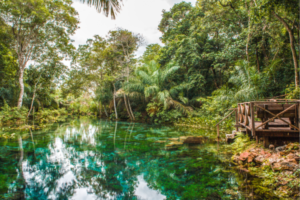

Underneath the cerrado of central Goiás, an enormous underground aquifer pushes hot water to the surface through 86 active wells, pumping around 1,200 cubic meters per hour at temperatures that reach 57°C. This has been happening for as long as anyone can remember, and it explains why a relatively small city in the Brazilian interior receives more domestic tourists per year than most of the country’s beach destinations.
Caldas Novas is the world’s largest hydrothermal resort — a title backed by the scale of what sits beneath the city, not just a marketing claim. The hot springs here are not a handful of artisanal pools. They are the foundation of an entire resort economy: water parks, spa resorts, thermal clubs, and hotel complexes that collectively account for over 100 thermal pools, fed by the same aquifer system that produces water warm enough to cook in at its source.
For international travelers, Caldas Novas sits comfortably outside the typical Brazil itinerary — and that’s partly what makes it interesting. There are no beaches, no colonial cobblestones, no famous carnival. What there is: a city that does hot water on an industrial scale, does it well, and surrounds it with enough food, nightlife, ecotrailing, and family infrastructure to justify several days.
🧳 Plan your trip to Brazil
🏨 Hotels: Browse the best hotels on Booking.com
🎟️ Tours & activities: Find tours on Civitatis ·
🚗 Car rental: Compare prices on Rentcars
🛡️ Travel insurance: Get a quote here
Where is Caldas Novas?
Caldas Novas is located in the state of Goiás, in central-west Brazil, approximately 185 km south of Goiânia (the state capital) and 280 km south of Brasília. It sits at an altitude of around 740 meters above sea level in the Brazilian cerrado — the vast tropical savanna that covers most of the country’s interior.
The city is accessible by road from São Paulo (approximately 900 km, about 9 hours), Brasília (280 km, roughly 3 hours), and Goiânia (185 km, about 2 hours). Its own airport, the Nelson Ribeiro Guimarães Airport (CLV), sits about 2.8 km from the city center and receives regional flights from major Brazilian cities.
About 30 km west of Caldas Novas, the municipality of Rio Quente is often treated as part of the same destination — it’s home to the Hot Park, one of the region’s largest water parks, and the Costa do Sauípe-style resort complexes that most international visitors associate with “thermas Brazil.” The two cities together form what Brazilians simply call the “região das thermas.”
For broader context on the region, see our Central-West Brazil travel guides.
A brief history
Indigenous Kayapó and Bororo peoples lived in this region for centuries before Portuguese colonizers arrived, drawn initially by gold and later by the strange phenomenon of water that came out of the ground already hot. The springs were documented by colonizers in the 18th century, and the settlement that grew around them was officially elevated to municipality status in 1911.
For most of the 20th century, Caldas Novas developed as a domestic health tourism destination — the thermal waters were believed to have therapeutic properties, and Brazilians came from the cities to take cures. The resort economy built on top of this tradition accelerated from the 1970s onward, when water parks and family resorts began replacing the old sanatorium-style establishments. The city today is the product of those five decades of rapid tourist infrastructure development, and it shows: the hotels are plentiful, the parks are large, and the entire urban economy is oriented around visitor spend.
The thermal springs: what you need to know
Before getting into specific attractions, it helps to understand how the thermal system here actually works.
The Caldas Novas aquifer produces water naturally heated by geothermal activity deep underground. The water rises to the surface at temperatures between 43°C and 57°C, is then cooled or blended to safe swimming temperatures (typically 35–42°C depending on the pool), and fed into the resort complexes, clubs, and water parks that draw millions of visitors annually. The underground reservoir is estimated to cover an area of approximately 130,000 km², making it genuinely one of the largest hydrothermal systems in the world.
The waters are rich in minerals — primarily calcium, magnesium, and sodium — and have a long tradition in Brazilian folk medicine as beneficial for rheumatism, skin conditions, and circulatory problems. Whether or not you’re coming for therapeutic reasons, the practical effect of spending a morning in pools at 38°C is straightforward: the heat is deeply relaxing, the mineral content leaves skin feeling smooth, and the combination of warm water and cerrado air is genuinely pleasant in a way that doesn’t require scientific backing to appreciate.
The water quality is regularly tested and considered safe for all ages. Children and elderly visitors make up a significant portion of the city’s visitors, and the infrastructure reflects this.
Main attractions in Caldas Novas
diRoma Acqua Park
The largest and most visited water park in the city — and one of the largest in Brazil — diRoma Acqua Park is the flagship of the diRoma resort complex, which also encompasses several hotels (diRoma Resort, L’acqua diRoma, Piazza diRoma) with shared access to the park.
The park covers a significant area with a wave pool, lazy river, multiple high-speed slides (including the “cápsula radical,” a near-vertical drop slide), and a dedicated children’s section. Thermal pools at various temperatures are integrated throughout the complex, meaning you can transition from a fast slide directly into a warm soak. It’s designed to accommodate large numbers of people and does so reasonably well, though in peak season (January and July) the queues for the most popular slides are real.
Entry for non-hotel guests runs approximately R$120–180 per day depending on the season. Guests staying at the diRoma hotels have included access. The complex opens daily from 9am.
Hot Park (Rio Quente)
Located 30 km west in the municipality of Rio Quente, Hot Park is the closest equivalent to a major international water park that Brazil has produced. The park occupies a large area with over 40 water attractions — slides, wave pools, lazy rivers, and the Corumbá River running through part of the complex. The Corumbá River integration is the distinctive element: sections of the real river are incorporated into the park experience, with natural thermal water feeding some of the pools and the overall landscape feeling more organic than a standard concrete water park.
Entry costs approximately R$150–230 per day depending on season. The resort complex around Hot Park (the Rio Quente Resorts properties) is the most internationally polished accommodation option in the region.
Book a Hot Park day trip from Goiânia with Civitatis — organized transport from Goiânia with park entry included, a practical option for visitors based in the state capital.
Lagoa Termas Parque
One of the older and more traditional thermal clubs in Caldas Novas — the Lagoa Termas Parque has been operating since the early days of the city’s tourism development and retains a character that the newer mega-resorts have traded away. Eight pools, saunas, thermal showers, and a setting within cerrado vegetation at water temperatures around 37.5°C. The atmosphere is quieter and more spa-oriented than the big water parks.
This is the recommendation for visitors who want thermal water experience without the slides, crowds, and adrenaline of the major parks. Entry costs around R$80–120.
Parque Estadual da Serra de Caldas Novas
The state park sits about 15 km from the city center and covers around 12,000 hectares of preserved cerrado. The park has marked trails, several waterfalls (including Cascatinha and Cascata Paredão), and an observation deck with panoramic views over the region. It’s the best option in the immediate area for people who want to spend time outdoors in nature rather than in pools.
Entry costs R$27. Guided trail options are available and recommended for the longer routes, which pass through dense cerrado vegetation and require some navigation.
Clube Privê and other thermal clubs
Beyond the large water parks, Caldas Novas has approximately 20 additional thermal clubs and smaller spa facilities scattered through the city and surroundings. The Clube Privê is one of the more popular among domestic visitors for its slightly more relaxed atmosphere and reasonable pricing. Most clubs charge R$40–80 per day and offer a quieter alternative to the mega-parks, with pools at different temperatures, food service, and the basic infrastructure of a Brazilian club experience.
Feira do Luar and Praça Central
The central square comes alive in the evenings with the Feira do Luar — a nightly market selling local handicrafts, regional food, jewelry (Goiás state is famous for its semi-precious stones), and the kind of casual street food that serves as background to any Brazilian public gathering. It’s free, it runs every night during peak season, and it’s where the city’s social energy concentrates after the water parks close.
Serra Verde Shopping
Not a typical shopping mall but a tourist attraction in its own right — Serra Verde is known for its distinctive architecture and as the best place in the city to buy artisanal chocolates, regional sweets, and semi-precious stones from Goiás. Worth an hour if you’re in the city center.

Day trips from Caldas Novas
Goiânia — the circular city
The state capital of Goiás is 185 km north of Caldas Novas — about 2 hours by car. Goiânia is one of Brazil’s most planned cities (designed in the 1930s with a radial street layout that makes navigation either very logical or very confusing, depending on your orientation), with good museums, excellent food, and a cultural scene that visitors based in Caldas Novas rarely explore. The Mercado Central de Goiânia is particularly good — fresh produce, regional specialties, and the opportunity to try genuinely local goiano food beyond what the resort restaurants serve.
Book a panoramic bus tour of Goiânia with Civitatis — a good introduction to the capital if you’re making the trip and want guided context.
Book a Caldas Novas water parks day trip from Goiânia with Civitatis — for travelers based in Goiânia who want to experience the thermal parks without an overnight stay.
Corumbá River and natural swimming
The Corumbá River, which runs through the Hot Park complex in Rio Quente, also has natural swimming spots accessible outside the park. Local operators offer boat rentals and guided river excursions. The water is warm (heated by the same geothermal system), clear, and lined with cerrado vegetation — a genuinely good outdoor alternative to the pool environment.
Pirenópolis
About 190 km northeast of Caldas Novas, Pirenópolis is one of the best-preserved colonial towns in Goiás state — cobblestone streets, baroque churches, and a well-developed ecotourism infrastructure based around the Pireneus mountain range and its waterfalls. It’s a popular day trip from Goiânia and works as an overnight addition to a longer Goiás itinerary. The contrast between Pirenópolis’s colonial character and Caldas Novas’s resort modernity captures two very different faces of the same state.
Chapada dos Veadeiros
About 330 km north of Caldas Novas, the Chapada dos Veadeiros National Park is one of the most spectacular natural areas in central Brazil — waterfalls, quartz crystal formations, cerrado highland landscapes, and some of the best hiking in the country. It’s too far for a comfortable day trip but works well as an extension of a central Goiás itinerary, particularly for visitors spending a week or more in the region.
How to get to Caldas Novas
By air
The Nelson Ribeiro Guimarães Airport (CLV) in Caldas Novas receives flights from São Paulo, Rio de Janeiro, and other major Brazilian cities — Azul and GOL are the primary carriers. The airport is 2.8 km from the city center, and taxis and transfers take around 15–20 minutes to the main hotel areas.
For more flight options, the Goiânia Santa Genoveva Airport (GYN) is 185 km away (about 2 hours by road) and has more frequent and diverse connections. Many visitors fly to Goiânia and drive or take a bus to Caldas Novas.
By road
The drive from São Paulo takes approximately 9 hours (900 km) via the BR-050 and BR-153 highways. From Brasília, it’s about 3 hours (280 km). From Goiânia, 185 km and roughly 2 hours.
Having a car is genuinely useful in Caldas Novas — the resort complexes are spread across a relatively large area, and the day trip to Hot Park in Rio Quente (30 km) is much easier with your own transport. It’s also the best way to access the state park, the Corumbá River spots, and the secondary thermal clubs outside the immediate center.
Compare car rental rates in Goiânia and Caldas Novas on Rentcars.com — picking up at Goiânia airport and driving to Caldas Novas is the most flexible option for visitors combining the state capital with the thermal resort city.
By bus
Regular bus services connect Caldas Novas with Goiânia, Brasília, and São Paulo. The Goiânia connection runs multiple times daily and costs around R$50–80. From São Paulo, the overnight bus journey takes approximately 11–12 hours.
Where to stay
Caldas Novas’s accommodation options run almost entirely on the resort model, most of the significant hotels either have their own thermal pools or provide access to a partner water park. The choice between properties is primarily about which park you want to be closest to and how much you want to spend.
The diRoma group (diRoma Resort, L’acqua diRoma, L’acqua diRoma II, Piazza diRoma, diRoma Fiori) is the largest and most present brand in the city, with properties at various price points all sharing access to the diRoma Acqua Park. Prices range from around R$100 to R$194 per night depending on the specific property and season, and the park access makes these a reliable base.
Lagoa Quente Hotel and Rio das Pedras Thermas Hotel are well-reviewed options with thermal pool access and good overall infrastructure.
For visitors prioritizing the Hot Park experience in Rio Quente over the Caldas Novas water parks, the Rio Quente Resorts complex offers accommodation directly adjacent to the park, pricing is higher but the access is unmatched.
During January and July (the two main Brazilian holiday peaks), accommodation in Caldas Novas fills quickly and prices increase by 30–50%. Booking 6–8 weeks in advance for these periods is the minimum. The Christmas and New Year period (mid-December to early January) is the absolute peak — book months ahead or expect very limited options.

Best time to visit
January is the single busiest month, when Brazilian families on summer holiday fill every resort to capacity. The city feels maximally alive, the nightlife runs hard, and the energy is at its highest. It’s also hot (around 28–34°C), and the queues at the major water parks are longest. If the full-crowd holiday atmosphere is what you want, this is when to come. If not, there are better options.
July is the second peak, driven by the mid-year school holiday. The weather is drier and slightly cooler (22–28°C), which makes the warm water particularly appealing. The Caldas Novas Winter Festival (Festival de Inverno) runs in July with shows, concerts, and cultural events alongside the thermal park experience.
May, June, and August to November offer significantly shorter queues, lower accommodation prices, and a more relaxed version of the same experience. The thermal water doesn’t care about the season — it’s the same temperature year-round. The cerrado landscape is particularly attractive in September when the late dry-season flowering begins. This shoulder season period is consistently the best recommendation for international visitors who have flexibility in their dates.
Avoid Carnival week (February) if you want a quiet experience — the city receives up to 300,000 additional visitors during that period.
Is Caldas Novas safe?
Caldas Novas is considered one of the safer tourist destinations in central Brazil. The city’s economy is almost entirely oriented around tourism, and the concentrated nature of the resort infrastructure means most visitors spend their time in well-managed, secure environments.
The typical safety concerns of urban Brazil — petty theft in crowded areas, awareness on public streets at night — apply here, but at a lower intensity than in larger cities. Within the resort complexes, safety is generally excellent and the managed environment reduces most risks.
A few specific points for the thermal context: the parks have lifeguards at all pools and slides. Water temperatures are regulated. The state park trails are safe when accompanied by a guide but can be disorienting without one.
Travel insurance is worth having regardless of your destination in Brazil. SafetyWing covers medical emergencies across Brazil from approximately USD $42/month, including water-based activities and minor injuries that are common in water park environments. It’s a small cost relative to what it covers.
Food in Caldas Novas
The food scene in Caldas Novas reflects its Goiás identity more than its resort environment, which works in the visitor’s favor — goiana cuisine is genuinely good and tends to be underestimated.
The staples of Goiás cooking are hearty and honest: pequi (a distinctive cerrado fruit with a rich, pungent flavor that divides opinion but is unmistakably regional), empadão goiano (a deep-dish meat and vegetable pie that is one of the most satisfying things you can eat in central Brazil), arroz com pequi, and carne de sol served with mandioca frita and farofa. These appear on menus across the city and at the Feira do Luar at night.
Empadão Goiano da Tânia (4.7 stars, R$20–40) is the most consistently well-rated casual option in the city for traditional goiana food — affordable, generous, and genuinely good. Chicago Restaurante (4.6 stars) and Coliseu Grelhados (4.6 stars) are the strongest options for grilled meat.
Inside the resort water parks, the food tends toward expensive versions of standard Brazilian snacks — grilled meat, pizza, fast food. Eating outside the resort for at least one meal per day saves money and gives you a better sense of what the city actually tastes like.
Practical information
| Location | Goiás state, central-west Brazil |
| Altitude | ~740 meters above sea level |
| Distance from Goiânia | 185 km, ~2 hours |
| Distance from Brasília | 280 km, ~3 hours |
| Distance from São Paulo | ~900 km, ~9 hours |
| Airport | Nelson Ribeiro Guimarães Airport (CLV), 2.8 km from center |
| Alternative airport | Goiânia GYN, 185 km |
| Thermal water temperature | 35–42°C in pools; up to 57°C at source |
| Peak season | January, July, December |
| Best shoulder season | May–June, August–November |
| Currency | Brazilian Real (BRL) |
| Language | Portuguese; limited English in tourist areas |
| Safety | Generally safe; resort environments are well-managed |
Connectivity
Mobile coverage is good throughout Caldas Novas and the main resort areas. A Brazil eSIM card from Civitatis is a practical option for international visitors — activate before arrival for 4G coverage across Brazil.
How many days do you need?
Two days is the minimum for a meaningful experience — enough time for one full day at a major water park (diRoma or Hot Park), a morning at a quieter thermal club, and an evening at the Feira do Luar.
Three to four days is the recommended length for most visitors, adding the state park trails, the Corumbá River, a visit to Rio Quente’s Hot Park if you haven’t already, and enough time to decompress between active days. The thermal water experience benefits from repetition — the second morning soak is noticeably better than the first.
A week is possible for visitors combining Caldas Novas with Pirenópolis, Goiânia, or Chapada dos Veadeiros as part of a broader Goiás itinerary. Caldas Novas works well as a rest-and-recover stop between more active days in the cerrado interior.
Book your Caldas Novas experiences
Caldas Novas water parks day trip from Goiânia with Civitatis — transport and park entry from the state capital
Hot Park day trip from Goiânia with Civitatis — Rio Quente’s flagship water park
Panoramic bus tour of Goiânia with Civitatis — if you’re combining Caldas Novas with the state capital
Compare car rental rates in Goiânia and Caldas Novas on Rentcars.com — recommended for exploring the region independently
Get travel insurance from SafetyWing — from ~USD $42/month, covers water park activities and medical emergencies across Brazil
Get a Brazil eSIM card from Civitatis — national 4G coverage from arrival
Keep exploring central-west Brazil
Central-West Brazil travel guides
Frequently asked questions
What country is Caldas Novas in? Caldas Novas is in Brazil — specifically in Goiás state, in central-west Brazil, about 185 km south of the state capital Goiânia and 280 km from Brasília.
What is Caldas Novas known for? Caldas Novas sits above one of the world’s largest hydrothermal aquifer systems, producing natural hot spring water that feeds over 100 thermal pools, water parks, and resort complexes throughout the city. It receives millions of Brazilian domestic tourists annually and is considered the largest hot spring resort destination in the world.
What is the best time to visit Caldas Novas? The shoulder season months — May, June, August, September, and October — offer the best balance of good weather, shorter queues at the water parks, and lower accommodation prices. January and July are the busiest months, with the highest prices and longest wait times. The thermal water temperature is consistent year-round, so the experience at the pools is similar regardless of season.
How much does a 3-day trip to Caldas Novas cost? A mid-range 3-day visit — including accommodation at R$150–200/night at a resort with thermal pool access, two days of water park entry (R$120–180 per day), meals outside the park (R$40–100 per person), and local transport — typically runs R$1,500 to R$2,500 per person. Peak season (January, July) can add 30–50% to these figures.
Is Caldas Novas safe for tourists? Yes — Caldas Novas is considered one of the safer tourist destinations in Goiás state. The resort environments are well-managed and the city’s entire economy is oriented around visitor experience. Standard Brazilian urban precautions apply outside the resort areas, but the overall risk level is low by comparison with larger Brazilian cities.
How hot is the water in Caldas Novas? The water emerges from the ground at 43–57°C and is cooled or blended before entering resort pools, where it’s typically maintained at 35–42°C depending on the facility. Some specialty pools operate at the higher end of this range and are not recommended for extended soaking or for young children.
Is there an airport in Caldas Novas? Yes — the Nelson Ribeiro Guimarães Airport (CLV) is 2.8 km from the city center and receives flights from São Paulo and other major cities, primarily on Azul and GOL. For more flight options, Goiânia’s airport (GYN) is 185 km away with more frequent connections.
Disclosure: this article contains affiliate links. If you book through our links, we may earn a small commission at no extra cost to you. We only recommend services we genuinely trust.