
Most travelers fly into Cuiabá and immediately start thinking about how to get out of it. That would be a mistake. Cuiabá, Mato Grosso, Brazil — the capital of one of Brazil’s largest and wildest states — is the gateway to the Northern Pantanal, the world’s largest tropical wetland and one of the most extraordinary wildlife destinations on Earth. But Cuiabá is also a fascinating city in its own right: founded in a gold rush, built at the geographic center of South America, shaped by indigenous, African, and Portuguese cultures into something genuinely distinctive, and blessed with a dining scene built around the incredible freshwater fish of the Pantanal.
Cuiabá is the starting point for jaguar safaris, capybara sightings, caiman-spotting boat rides, crystal-clear river snorkeling, and the legendary Transpantaneira Highway, a dirt road running 147 km deep into the Pantanal across 122 wooden bridges, with wildlife visible from the car at almost every kilometer. No other city in Brazil puts you this close to this quality and quantity of wildlife.
This is your complete guide to Cuiabá, where it is, how to get there, what to do in the city, how to use it as a base for the Pantanal, where to eat and stay, when to go, and how to travel safely and confidently in one of Brazil’s most rewarding and underrated destinations.
🧳 Plan your trip to Brazil
🏨 Hotels: Browse the best hotels on Booking.com
🎟️ Tours & activities: Find tours on Civitatis ·
🚗 Car rental: Compare prices on Rentcars
🛡️ Travel insurance: Get a quote here
Where is Cuiabá? Location and context
Cuiabá is the capital of Mato Grosso state, located in the central-west region of Brazil, far from the coastal cities most international travelers focus on, but strategically positioned at the intersection of three of South America’s most important ecosystems: the Pantanal to the south and west, the Amazon Rainforest to the north, and the cerrado (Brazilian savanna) that surrounds the city.
Positioned near the geographic center of South America, Cuiabá plays a crucial role in connecting different regions of Brazil. The city is also known for its proximity to the Pantanal, one of the world’s largest tropical wetlands, and the Amazon Rainforest, making it an ideal base for ecotourism and wildlife observation.
The Centro Geodésico da América do Sul, the geographic center of South America, is actually located within Cuiabá’s city limits, marked by a monument that has become one of the city’s most visited landmarks. Standing at the center of a continent is a genuinely remarkable thing to be able to say.
Cuiabá has a population of approximately 650,000 people, making it a mid-sized Brazilian city with good infrastructure, reliable air connections, and a range of accommodation options. It’s hot — very hot — with temperatures regularly exceeding 40°C (104°F) in the warmer months. But its strategic location as the gateway to the Northern Pantanal makes it indispensable for wildlife travelers.
For broader regional context, explore our Central-West Brazil travel guides.
A brief history: Gold, indigenous cultures, and the center of a continent
Founded during the gold rush in the 18th century, Cuiabá quickly turned into an important commercial hub in the heart of Brazil. Its unique location has given rise to a fascinating mix of influences, visible in its colonial architecture, lively markets, and local cuisine influenced by indigenous, African, and Portuguese roots.
The city was officially founded in 1719 when gold was discovered in the Coxipó River, part of the great gold rush that drew Portuguese colonizers deep into Brazil’s interior. Cuiabá was one of the most remote gold-mining settlements in colonial Brazil, reachable only by months-long river journeys from the coast, which contributed to the isolation and cultural distinctiveness that still characterizes Mato Grosso today.
The indigenous heritage of the region is profound and still visible. Mato Grosso is home to dozens of indigenous nations, including the Bororo, Paresi, Xavante, and Kayapó peoples. The Xavante, in particular, are one of Brazil’s most culturally distinct and politically active indigenous groups, and their presence in Mato Grosso shapes the state’s cultural and political identity in important ways.
The Museu do Índio, located near the Federal University of Mato Grosso campus, houses one of the most significant collections of indigenous artifacts in Brazil, an essential stop for understanding the human landscape of the region you’re about to explore.
What to do in Cuiabá: city attractions
Centro Geodésico da América do Sul
Standing at the geographic center of South America is one of those quietly extraordinary travel moments that doesn’t require any particular effort, the monument is accessible, the location is meaningful, and the selfie is effortless. Cuiabá’s claim to be the “heart of South America” is literally true, and the Centro Geodésico monument in the Coxipó neighborhood commemorates this geographic fact. Free to visit.
Catedral Basílica do Senhor Bom Jesus
Cuiabá’s most important religious building and one of the most recognizable landmarks in the city center. a grand 19th-century cathedral facing the Praça da República, the central square. The interior is beautifully maintained and offers a cool respite from the heat. The cathedral is the spiritual anchor of the city and the starting point for any walking tour of the historic center.
Museu do Morro da Caixa D’Água Velha
Housed in a distinctive water tower building dating from the colonial era, this museum offers panoramic views over Cuiabá from the top and houses exhibits on the city’s history from its gold rush origins through to the present day. One of the most atmospheric and architecturally interesting museums in the city.
Museu de História Natural de Mato Grosso
One of the best natural history museums in central Brazil, with extensive collections covering the geology, paleontology, and biodiversity of Mato Grosso state. Particularly strong on the Pantanal ecosystem. an excellent place to orient yourself on the wildlife you’re about to encounter before heading into the wetlands.
Museu de Arte Sacra de Mato Grosso
A small but exceptional museum of sacred art. one of the highest-rated cultural attractions in Cuiabá (4.9 stars). housed in a beautifully restored colonial building with a collection that reflects the baroque religious culture brought by the Portuguese colonizers to this remote corner of their empire.
Parque Mãe Bonifácia
Cuiabá’s most popular urban park. a large green reserve within the city limits with walking trails through cerrado vegetation, exercise areas, a small creek, and a resident population of wild birds. A peaceful escape from the urban heat and one of the best places in the city to experience the cerrado ecosystem without leaving town. Entry is free.
Parque Tia Nair
Another well-loved urban park with strong ratings from locals. good for families, walking, and experiencing a slice of everyday Cuiabá life.

Orla do Porto
The waterfront promenade along the Cuiabá River. a popular evening gathering spot where locals walk, exercise, eat at riverside restaurants, and watch the sunset over the water. The Cuiabá River is one of the tributaries that feeds the Pantanal, and watching it here in the city gives you a first sense of the extraordinary ecosystem that begins just south.
Feira do Porto and local markets
Cuiabá’s riverside market area is one of the most authentic in central Brazil, a place where the city’s culinary culture is most visible, with fresh river fish, tropical fruits, regional crafts, and local food stalls serving traditional Mato Grosso dishes. Arrive early in the morning for the best experience.

The Pantanal: Why Cuiabá is your gateway
Everything above is a reason to spend a day or two in Cuiabá. But the reason most international visitors come here, and the reason Cuiabá belongs on every serious nature traveler’s radar, is the Northern Pantanal.
The Pantanal is the world’s largest tropical wetland, covering approximately 150,000–195,000 km² across Brazil, Bolivia, and Paraguay. It’s home to the highest concentration of wildlife in the Western Hemisphere: more than 650 bird species, 90 mammal species, 260 fish species, and 50 reptile species, all living in an ecosystem that alternates between flood and dry season in one of nature’s most dramatic annual cycles.
For adventurers exploring the Northern Pantanal, the gateway is Cuiabá, capital of Mato Grosso, accessible via Marechal Rondon International Airport (CGB). From Cuiabá, travelers usually drive about 100 kilometers to Poconé, the start of the famous Transpantaneira Highway.
The Transpantaneira Highway
The Transpantaneira is one of the most extraordinary wildlife drives on Earth. This unpaved dirt road runs 147 km from Poconé into the heart of the Northern Pantanal, crossing 122 wooden bridges — some of them alarmingly rickety — over rivers, streams, and flooded plains. Take it slow and you’ll get the chance to see amazing birdlife, anteaters, toucans and much more, but watch out for water crossings on the wooden bridges — they can be quite rickety.
Even driving slowly along the Transpantaneira in an ordinary car, wildlife sightings are almost constant: caimans sunbathing on the banks of every water crossing, capybaras grazing by the roadside, jabiru storks standing sentinel in flooded fields, toucans in the trees, and — with luck and patience — jaguars on the riverbanks.
Jaguar Safaris from Cuiabá
The Northern Pantanal around Porto Jofre, at the end of the Transpantaneira, is the world’s best location for seeing wild jaguars. The combination of the Cuiabá and Piquiri Rivers, the concentration of prey animals (particularly caimans and capybaras), and the flat, open terrain makes jaguar sightings by river boat remarkably reliable during the dry season. The dry season from July through October is really when you’ll get the best wildlife viewing in the Pantanal. The water levels drop which actually works in our favor because animals gather around the remaining water spots making them easier to spot.
Book a Mato Grosso Marshland Safari from Cuiabá with Civitatis — explore the vast Pantanal wetlands by both boat and safari vehicle, with expert local guides who know the wildlife and the terrain. This is the most comprehensive way to experience the Northern Pantanal from Cuiabá, combining land and river observation for maximum wildlife encounter opportunities.

Aquário Encantado de Nobres — crystal-clear river snorkeling
One of the most extraordinary and least-known natural attractions accessible from Cuiabá: the Aquário Encantado (Enchanted Aquarium) in the municipality of Nobres, approximately 130 km north of Cuiabá.
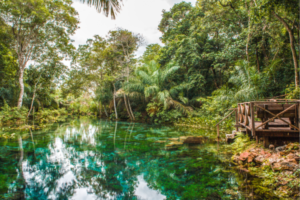
Come and discover the underwater wonders of Mato Grosso on this excursion to the Aquário Encantado in Nobres, where you’ll snorkel in crystal-clear waters. The springs here produce water of extraordinary clarity, visibility extends for dozens of meters underwater, in a natural pool surrounded by cerrado vegetation. Snorkeling here reveals an underwater landscape of freshwater fish, aquatic plants, and rock formations that feels more like a tropical marine environment than a river in central Brazil.
Book an Aquário Encantado de Nobres excursion from Cuiabá with Civitatis — transport, snorkeling equipment, and a guide covering the full Nobres experience.
Getting to Cuiabá
By air
Marechal Rondon International Airport (CGB) serves Cuiabá, located approximately 7 km from the city center. The airport is served by direct flights from Brazilian capitals including São Paulo, Rio de Janeiro, Belo Horizonte, and Brasília. Flight time from São Paulo is approximately 2 hours; from Rio de Janeiro approximately 2.5 hours.
From the airport, Uber and 99Pop are the most convenient options for reaching city hotels. Taxis are available at the official taxi rank, confirm the fare before getting in.
By road
Cuiabá is connected to the rest of Brazil by major federal highways, but the distances are significant, it’s approximately 1,500 km from São Paulo by road, making road travel practical only from relatively nearby cities or as part of a longer road trip through central Brazil.
Getting around Cuiabá and the Pantanal
Within Cuiabá city, Uber and 99Pop work reliably and are the recommended transport option. For the Pantanal excursions — particularly for the Transpantaneira Highway — renting a car gives you significant independence. A 4×4 or high-clearance vehicle is strongly recommended for the Transpantaneira, particularly during or immediately after the rainy season when the road can be muddy.
Compare car rental rates in Cuiabá on Rentcars.com — search multiple suppliers including airport pickup options. For the Pantanal specifically, look for a vehicle with good ground clearance.

Where to stay in Cuiabá
Most visitors to Cuiabá stay in the city for 1–2 nights — enough to see the main attractions — before heading into the Pantanal for the wildlife experience. A second option is to stay at a Pantanal lodge directly, using Cuiabá only as an arrival and departure point.
Hotel Gran Odara (4.8 stars, R$587/night) is the most highly rated hotel in Cuiabá, a genuinely excellent property with facilities and service that punch well above the city’s size.
Hotel Deville Prime Cuiabá (4.7 stars, R$634/night) is the most internationally polished option — a business-class property with pool, restaurant, and full facilities. The preferred choice for international travelers who want reliable comfort.
Hotel Fazenda Mato Grosso (4.4 stars, R$337/night) offers a more distinctive experience — a farm-hotel format that gives a sense of the rural Mato Grosso identity even within reach of the city. 5,800+ reviews reflect its popularity with Brazilian domestic travelers.
Delcas Hotel (4.1 stars, R$318/night) is a reliable mid-range option with good central location and solid facilities, a practical choice for travelers prioritizing value.
For those preferring a Pantanal lodge experience directly, numerous fazenda-style eco-lodges operate along the Transpantaneira Highway and in the Porto Jofre area. These range from rustic to genuinely luxurious and typically include meals, guided activities, and wildlife excursions in the daily rate. Book these well in advance, the best lodges fill months ahead for peak dry season (July–October).
Best time to visit Cuiabá and the Pantanal
The timing of your Cuiabá visit is arguably the most important planning decision you’ll make — it determines what you’ll see, how you’ll access the Pantanal, and what the experience will feel like.
Dry Season (may to september) — best for wildlife
The dry season, from May to September, is generally considered the best time to visit for wildlife spotting and outdoor activities. Temperatures are pleasant, and rain is rare, making excursions into the Pantanal and day trips much more enjoyable.
During the dry season, the Pantanal’s water levels drop and wildlife concentrates around remaining water sources, dramatically increasing sighting rates for all species. July and August are the absolute peak months for jaguar sightings along the rivers around Porto Jofre. This is when the Pantanal delivers its most spectacular wildlife show.
The tradeoff is temperature: Cuiabá is hot year-round, but the dry season brings relief from humidity. Temperatures of 28–35°C (82–95°F) are typical.
Wet Season (november to march) — dramatic landscapes
The wet season transforms the Pantanal entirely, the wetlands flood, creating a vast inland sea that is beautiful from above and navigable primarily by boat. Bird breeding season begins, producing spectacular concentrations of nesting jabiru storks, roseate spoonbills, and herons. Pink river dolphins (boto) move deeper into the flooded forest and are often more accessible.
The tradeoff: road access via the Transpantaneira becomes challenging, and some lodges reduce operations. The heat and humidity in Cuiabá city are at their most intense.
Shoulder seasons (april, october) — good balance
April and October offer a compromise, moderate wildlife visibility, more reliable road conditions, and slightly more reasonable temperatures. Good options for travelers with flexible schedules.

Is Cuiabá safe? Honest tips for international visitors
Cuiabá is a mid-sized Brazilian city that requires the same level of awareness as any similar urban destination in the country. The tourist areas — the city center around the cathedral, the university area, and the main hotel districts — are generally safe during daytime hours.
Practical safety tips for Cuiabá:
- Use Uber or 99Pop for all transport, especially after dark
- Stay in the main hotel districts, most international-standard properties are in safe, well-lit areas
- Keep valuables secured and avoid displaying expensive cameras or jewelry in markets and busy public spaces
- The Orla do Porto waterfront is pleasant but exercise standard caution at night
- Ask your hotel for current advice on neighborhoods to avoid
For Pantanal excursions:
- Always use licensed, professional tour operators — never venture into the Pantanal alone or without a guide
- Wildlife in the Pantanal is wild — maintain appropriate distances from all animals, particularly caimans and jaguars
- Bring insect repellent for all outdoor activities — mosquitoes in the Pantanal are significant, particularly during and after the rainy season
- Carry sufficient water — the heat in central Brazil is intense and dehydration risks are real
Travel insurance is essential. With travel insurance, you can travel with peace of mind and focus solely on unwinding and enjoying your holiday. Medical facilities in Cuiabá city are adequate, but remote Pantanal lodges are far from hospital care.
SafetyWing offers flexible international coverage from ~USD $42/month, including medical emergencies and evacuation coverage for remote areas. Non-negotiable for any Pantanal adventure.
Food in Cuiabá: the cuisine of Mato Grosso
Cuiabá has one of the most distinctive regional cuisines in Brazil — built around the extraordinary freshwater fish of the Pantanal rivers and the agricultural and indigenous traditions of Mato Grosso.
Pacu grelhado is the flagship dish — pacu is a large, flat Pantanal fish with rich, fatty flesh that grills beautifully. Every serious restaurant in Cuiabá serves it. Lélis Peixaria (4.7 stars, one of the most-reviewed restaurants in the city) is the temple of this tradition — a must-visit for anyone who loves fresh fish.
Pintado is another Pantanal fish that appears constantly on menus — meatier and more mild than pacu, excellent in the local moqueca (stew) preparation.
Caldo de piranha — piranha soup. Yes, the piranha of Pantanal fame is also a local delicacy — a rich, intensely flavored broth made from the fish that inspires so much respect elsewhere. Try it at the Feira do Porto market.
Arroz com pequi — rice cooked with pequi fruit, a distinctive Cerrado ingredient with a pungent, complex flavor that divides opinion but is deeply characteristic of central Brazilian cuisine.
Top restaurant picks in Cuiabá:
- Lélis Peixaria (4.7 stars, 3,900+ reviews) — the definitive Cuiabá fish restaurant experience
- Mahalo Cozinha Criativa (4.7 stars) — creative contemporary cooking with regional ingredients
- Detroit American Steakhouse (4.6 stars, 4,700+ reviews) — for the excellent Brazilian beef that’s never far from the menu in cattle-country Mato Grosso
- Restaurante e Bar Varadero (4.6 stars) — a local institution for traditional Mato Grosso cuisine and atmosphere
Practical information for international visitors
| Location | Mato Grosso state, central-west Brazil |
| Airport | Marechal Rondon International Airport (CGB), ~7 km from center |
| Flights from São Paulo | ~2 hours |
| Flights from Rio de Janeiro | ~2.5 hours |
| Currency | Brazilian Real (BRL) |
| Language | Portuguese; very limited English outside major hotels |
| Best season for wildlife | July–October (dry season peak) |
| Best season for birds | November–March (wet season breeding) |
| Average temperature | 28–38°C (82–100°F) year-round |
| Recommended stay | 1–2 nights Cuiabá + 3–7 nights in the Pantanal |
| Safety | Standard urban caution in the city; professional guides essential in the Pantanal |
Coordinates of Cuiabá, Brazil
For travelers using GPS or planning routes: Cuiabá is located at approximately 15°36′S, 56°06′W, confirming its position near the geographic center of South America, close to the Pantanal and at the transition zone between the Amazon, the cerrado, and the wetlands.
What time is it in Cuiabá?
Cuiabá follows Mato Grosso Time (AMT — Amazon Time), which is UTC-4 — one hour behind Brasília Time (BRT). This is the same time zone as the Amazon region. When planning calls, connections, or coordination with other parts of Brazil, note the one-hour difference from Rio de Janeiro and São Paulo.
Connectivity
Mobile coverage is good in Cuiabá city and the main towns, but remote Pantanal lodges often have limited or no signal. A Brazil eSIM card from Civitatis is a practical solution for staying connected throughout your trip, easy to activate before arrival with national 4G coverage.
How many days do you need?
1–2 days in Cuiabá: Covers the city center highlights — cathedral, Centro Geodésico, Museu do Índio, Parque Mãe Bonifácia, Orla do Porto, and a fresh fish lunch at Lélis Peixaria. Good for travelers using the city purely as an arrival/departure point for the Pantanal.
3–5 days total (city + Pantanal day trips): Adds a full-day safari in the Pantanal with the Civitatis Mato Grosso marshland tour, and potentially a day trip to Aquário Encantado de Nobres. A solid introduction to both the city and the ecosystem.
7–10 days: The ideal for travelers who want the full Northern Pantanal experience — 1–2 nights in Cuiabá plus 5–7 nights at a Pantanal lodge along the Transpantaneira, with jaguar safaris, night boat tours, bird watching expeditions, and complete wildlife immersion.
Book your Cuiabá and Pantanal experiences
→Mato Grosso Marshland Safari from Cuiabá — boat and safari vehicle, expert wildlife guides, Northern Pantanal
→Aquário Encantado de Nobres excursion — crystal-clear river snorkeling in the Mato Grosso cerrado
→Compare car rental rates in Cuiabá on Rentcars.com — essential for independent Transpantaneira exploration; look for 4×4 options
→Get travel insurance from SafetyWing — from ~USD $42/month; non-negotiable for remote wildlife destinations
→Get a Brazil eSIM card — national 4G coverage including urban areas (Pantanal lodges may have limited signal regardless)
Keep exploring Central-West Brazil
Frequently Asked Questions about Cuiabá
Where is Cuiabá located in Brazil? Cuiabá is the capital of Mato Grosso state, in central-west Brazil. It sits near the geographic center of South America and serves as the primary gateway to the Northern Pantanal. It is approximately 1,500 km from São Paulo and 2 flight hours from most major Brazilian cities.
What is Cuiabá, Mato Grosso, Brazil known for? Cuiabá is primarily known as the gateway city for the Northern Pantanal — the world’s largest tropical wetland and one of the best wildlife destinations on Earth. It’s also known for its gold rush history, indigenous cultural heritage, Pantanal fish cuisine, and its position at the geographic center of South America.
What is the best time to visit Cuiabá? The dry season from May to September offers the best wildlife viewing in the Pantanal — July and August are peak jaguar sighting months. The wet season (November–March) offers different experiences including spectacular bird breeding and flooded forest boat tours, but road access can be limited.
How do I get from Cuiabá to the Pantanal? From Cuiabá, drive approximately 100 km to Poconé, which marks the start of the Transpantaneira Highway. This 147 km unpaved road runs deep into the Northern Pantanal with 122 wooden bridges. A rental car with good clearance is recommended; organized tours are available for those who prefer guided access.
What wildlife can I see near Cuiabá? The Northern Pantanal accessible from Cuiabá is home to jaguars, giant otters, caimans, capybaras, tapirs, giant anteaters, hyacinth macaws, jabiru storks, roseate spoonbills, over 650 bird species, and dozens of other mammals and reptiles. Jaguar sightings by river boat are remarkably reliable in the dry season around Porto Jofre.
Is Cuiabá safe for tourists? Cuiabá is a mid-sized Brazilian city that requires standard urban travel awareness. The main tourist areas, hotel districts, and historic center are generally safe during daytime hours. Use Uber for transport, stay in established tourist areas, and always use licensed professional guides for Pantanal excursions.
What is the weather like in Cuiabá? Cuiabá is one of the hottest cities in Brazil, with average temperatures of 28–38°C (82–100°F) year-round. The dry season (May–September) offers lower humidity and more bearable heat. The wet season (November–March) is hotter and more humid, with afternoon thunderstorms common.
Disclosure: This article contains affiliate links. If you book through our links, we may earn a small commission at no extra cost to you. We only recommend services we genuinely trust and believe will enhance your trip.