
The first thing that hits you about Balneário Camboriú is the skyline. A wall of skyscrapers rising directly from a curved beach, so dense and so tall that they cast long shadows across the sand by mid-afternoon. It looks nothing like the rest of Brazil. It looks, frankly, a bit like someone airlifted a section of Miami Beach to the coast of Santa Catarina and forgot to stop building.
That’s not a criticism. Balneário Camboriú — BC to everyone who knows it — is one of Brazil’s most unapologetically ambitious beach cities, and it owns that identity completely. The cable car that crosses forested hills from one beach to another. The Ferris wheel visible from half the coast. The nightlife that runs until the early hours along Avenida Atlântica. The aquarium with penguins and sharks. The dinosaur park with 82,000 reviews on Google. Brazil does beach resort culture better than most countries, and BC does it at full volume.
For international visitors, it’s a city that either works perfectly or feels a bit much, depending on what you’re looking for. This guide gives you the information to decide — and to get the most out of it if you go.
🧳 Plan your trip to Brazil
🏨 Hotels: Browse the best hotels on Booking.com
🎟️ Tours & activities: Find tours on Civitatis ·
🚗 Car rental: Compare prices on Rentcars
🛡️ Travel insurance: Get a quote here
Where is Balneário Camboriú?
Balneário Camboriú is located in Santa Catarina state, in southern Brazil, on the Atlantic coast. It sits 80 km north of Florianópolis (the state capital) and about 10 km from Itajaí, which has the nearest commercial airport. São Paulo is approximately 700 km to the north.
The city occupies a horseshoe-shaped bay surrounded by hills covered in Atlantic Forest. The main beach — Praia Central — runs along the bottom of the horseshoe, with the Camboriú River mouth at the north end and Barra Sul at the south. To the south of Barra Sul, the hills begin and the smaller, wilder beaches start: Taquaras, Estaleirinho, Pinho, and others that are accessible on foot or by boat.
The metropolitan area includes the neighboring city of Camboriú (a separate municipality, often confused with Balneário Camboriú — they are different cities, with Balneário Camboriú being the beach destination and Camboriú the inland city). The distinction matters when booking transport or accommodation.
For broader context on the region, see our guides to Santa Catarina and South Brazil.
A brief history
The area was originally inhabited by the Carijó indigenous people and later settled by Portuguese colonizers in the 18th century. For most of its history, the bay was a quiet fishing community living off the ocean and the Camboriú River.
The shift toward tourism happened in the second half of the 20th century, accelerating rapidly from the 1970s onward as São Paulo’s growing middle class discovered the Santa Catarina coast. Investment in high-rise apartment buildings followed demand, and the skyline that defines BC today is essentially the product of four decades of construction without meaningful limits on building height.
The city was officially separated from Camboriú as its own municipality in 1964. Today it has a permanent population of around 150,000 — but that number swells to over a million during the January summer peak, making it one of the most visited beach cities in all of South America by visitor-to-resident ratio.

The beaches
Praia Central
The main beach is about 5 km long and runs the full width of the bay. It’s wide, well-maintained, has good infrastructure (beach kiosks, lifeguards, clean sand), and faces east, which means beautiful morning light and warm water for swimming. The water clarity is not Caribbean-level — this is an urban beach in a busy bay — but it’s perfectly clean for swimming and the conditions are generally calm, particularly at the northern end.
The promenade, Avenida Atlântica, runs behind the beach with a dedicated cycle lane, restaurants, bars, and the kind of constant pedestrian traffic that makes people-watching a genuine activity. At night, the promenade lights up and becomes one of the most active stretches of any beach city in Brazil.
The beach gets very busy in January and February. If you’re visiting in peak season, arrive early — the best spots go quickly.
Praia de Laranjeiras
Reached by the Unipraias cable car or by boat, Laranjeiras is a more sheltered cove on the other side of the hill from the city center. The water is calmer and cleaner, the atmosphere noticeably quieter, and the scale more intimate than Praia Central. Most visitors combine a cable car ride with time on Laranjeiras beach — it works well as a half-day combination.
Praia Brava
Located north of the city center beyond the Molhe da Barra Norte, Praia Brava is where the city’s nightlife crowd gravitates on weekends and where beach parties happen throughout the summer. The beach itself is open and exposed, with stronger waves than Praia Central — decent for surfing, popular with younger visitors, and the address of several beach clubs that operate well into the evening.
Praia de Taquaras and the southern beaches
The beaches south of Barra Sul have a different character entirely. Taquaras, Estaleirinho, and the more remote Pinho (Brazil’s first official naturist beach) require either a boat or a walk through Atlantic Forest trails. They’re progressively quieter and less developed the further south you go.
Praia do Estaleirinho is particularly good — clear water, upscale beach clubs, and a natural setting that contrasts sharply with the skyscrapers visible in the distance. Worth the effort to reach independently.

Top things to do in Balneário Camboriú
Parque Unipraias
The cable car park is the most visited attraction in the city with reason. Three cable car stations connect the south end of Praia Central, up through the Atlantic Forest to a midpoint on Morro da Aguada, then down to Praia de Laranjeiras. The views across the city and coastline from the midpoint station are genuinely excellent.
The park has expanded significantly in recent years and now includes a zipline, the Youhooo! mountain sled (a fast toboggan down the hillside), an elevated forest walk (ararapuca), and panoramic lookout platforms. Entry to the cable car costs around R$80, with individual attractions priced separately.
Book the Unipraias cable car and pirate boat ride combo with Civitatis — combines the cable car crossing with a boat trip around the bay.
Summit BC observation deck
One of the more recent additions to BC’s skyline experience: an observation deck on one of the city’s tallest residential buildings, offering 360-degree views from a height that puts you eye-level with the upper floors of the surrounding towers. It’s not the Burj Khalifa, but the perspective — looking down at the beach from inside the skyscraper wall — is arresting.
Book Summit BC observation deck tickets with Civitatis — skip the queue with advance tickets.
Cristo Luz monument
On a hilltop above the city, the Cristo Luz is a 33-meter illuminated Christ figure that serves as BC’s most visible landmark after dark. The monument is accessible by cable car from the city (separate from Unipraias) and the hilltop has panoramic views across the full city and coastline, particularly spectacular at sunset. During summer months, the complex has a restaurant and live music in the evenings.
Entry costs around R$80.
Book Cristo Luz tickets with Civitatis — advance tickets include the cable car ascent and the monument grounds.
Oceanic Aquarium (Acqua Mundo)
With over 110,000 Google reviews and a 4.8-star rating, the Oceanic Aquarium is one of the most visited in Brazil. The facility houses more than 250 marine species across 25 themed habitats — including sharks, penguins, stingrays, turtles, and a wide range of Atlantic fish. A tunnel walkway through the main tank is the centerpiece.
Entry costs around R$39.90.
Book Oceanic Aquarium tickets with Civitatis — advance purchase recommended in peak season when queues can be long.
Ferris wheel (Roda FG)
At 88 meters tall, the Roda FG is one of the tallest Ferris wheels in South America, positioned near the beachfront to maximize the view of the skyline and coastline from the top. The pods are glass-enclosed and climate-controlled, and a full rotation takes about 15 minutes. Entry costs around R$64.
Book Ferris wheel tickets with Civitatis — worth booking in advance during summer and holiday weekends.
Parque dos Dinossauros — Aventura Jurássica
With 82,000 Google reviews and a 4.9-star rating, this is one of the highest-rated attractions in the city — a large outdoor park with life-size dinosaur replicas spread through an Atlantic Forest setting, with activities for children and adults. It’s clearly oriented toward families but the scale and production value are impressive.
Book Aventura Jurássica tickets with Civitatis — advance tickets recommended in peak season.
Pirate Adventure
An interactive pirate-themed experience with 58,000 reviews and a 4.9-star rating — consistently one of the most popular family attractions in the city. The format combines theatrical storytelling with adventure activities in a dedicated facility.
Book Pirate Adventure tickets with Civitatis — one of BC’s most popular family activities.
Classic car show
For a more niche experience, BC hosts a well-regarded classic car exhibition that draws enthusiasts and casual visitors alike.
Book classic car show tickets with Civitatis — an unexpected find in a beach city, and surprisingly popular.

Day trips from Balneário Camboriú
Beto Carrero World — Latin America’s largest theme park
Located in Penha, about 40 km (approximately 40 minutes) from BC, Beto Carrero World is Brazil’s most ambitious theme park — and by most measurements, the largest in Latin America. The park covers a vast area with themed zones including adventure, wildlife, western, and children’s sections, with rides, shows, and a genuine zoo within the complex. A full day is needed to do it justice, and it works best for families or visitors who haven’t had their fill of large-scale attractions.
Book a day trip to Beto Carrero World from Balneário Camboriú with Civitatis — transport and park entry included.
Florianópolis
The state capital of Santa Catarina is 80 km south of BC — about an hour by car or bus — and offers a genuinely different experience: colonial history, the Mercado Público, excellent northern beaches (Jurerê, Daniela), and a more culturally varied city atmosphere. Florianópolis works well as a day trip if you’re based in BC and want to see more of the state.
Book a Florianópolis excursion from Balneário Camboriú with Civitatis — a guided day trip covering the capital’s main highlights.
Bombinhas and snorkeling
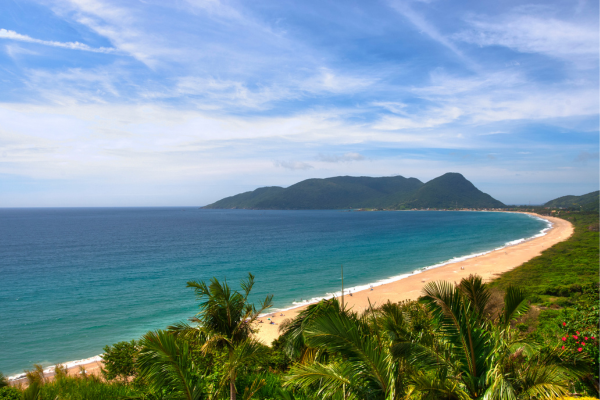
Bombinhas, about 60 km south of BC, is one of Santa Catarina’s best coastal destinations for snorkeling and diving. The clarity of the water around the Bombinhas peninsula is significantly better than in the main BC bay, and organized snorkeling tours access sites with good marine life visibility.
Book a Bombinhas trip with snorkeling at Sepultura beach from BC with Civitatis — transport, snorkeling equipment, and guide included.
Blumenau and Pomerode — the German valley
Heading inland from BC, the Vale Europeu (European Valley) of Santa Catarina contains some of the most striking German and Pomeranian immigrant towns in Brazil. Blumenau is famous for its Oktoberfest — the second-largest in the world after Munich — its craft beer culture, and its distinctly Germanic architecture. Pomerode, 30 km from Blumenau, is the city with the highest proportion of German speakers in Brazil and has an extraordinarily preserved traditional character.
Book a Blumenau and Pomerode tour from Navegantes (near BC) with Civitatis — a guided excursion to the European Valley including the Beer Museum in Blumenau and the historic center of Pomerode.
How to get to Balneário Camboriú
By air
The nearest commercial airport is Navegantes Ministro Victor Konder International Airport (NVT), approximately 20 km north of BC. The airport receives regular flights from São Paulo, Rio de Janeiro, Brasília, and other major Brazilian cities. Azul and Gol are the primary carriers on this route. From the airport, taxis, Uber, and shuttles connect to BC in about 20 minutes.
Florianópolis International Airport (FLN), 90 km to the south, has more flight options including some international routes. From Florianópolis airport, the transfer to BC takes about 1.5 hours by car or bus.
Book transfers to or from Balneário Camboriú with Civitatis — door-to-door service from either airport.
By car from São Paulo
The drive from São Paulo takes approximately 7 to 8 hours via the BR-101 or the Via Dutra/BR-116 connecting to the coastal road. This is a popular route for Brazilian domestic travelers and the road is well-maintained. Having a car in BC is useful for accessing the southern beaches and making day trips independently.
Compare car rental rates in Florianópolis or Navegantes on Rentcars.com — pick-up at either airport is straightforward and gives you flexibility for the whole Santa Catarina coast.
Getting around
The city center is walkable and the beachfront promenade is ideal for cycling (rental bikes are available along Avenida Atlântica). Uber works well throughout the city. For the southern beaches and out-of-city attractions, taxis or a rental car are the practical options.
Where to stay
The vast majority of BC’s accommodation runs along the seafront and the streets immediately behind it. Proximity to the beach is the primary consideration for most visitors.
Mercure Balneário Camboriú, HM Hotel, Hotel Plaza Camboriú and Hotel Negrini are the most consistently well-reviewed mid-to-upper-range options. Marambaia Hotel has over 4,700 reviews and represents good value at its price point.
For mid-range stays, Miramar Hotel and ibis budget offer reliable, clean accommodation at practical prices. The ibis budget in particular is well-positioned for its category.
During January — Brazil’s summer holiday peak — accommodation prices in BC roughly double, availability drops sharply, and the city can feel overwhelmed by visitors. If January is your only option, book 2–3 months in advance. The spring shoulder season (September to November) gives you good weather, far smaller crowds, and much better prices.
Best time to visit
December to February is summer and peak season. Temperatures sit around 25–30°C, the water is warm, and the city operates at full energy. It’s when BC is at its most festive — and its most crowded and expensive. January in particular sees the city’s population multiply several times over. If you want the full BC party atmosphere, this is when to come. Book everything early.
March to May sees the crowds thin, prices come down, and the weather remain warm enough for comfortable beach days. A good option for visitors who want the beach experience without the January intensity.
June to August is cooler (15–22°C) and much quieter. Some beach kiosks and attractions reduce hours or close. Not the classic BC experience, but if you’re combining it with the nearby mountain towns or the wine country further south, this works as part of a broader Santa Catarina itinerary.
September to November is spring and arguably the best balance. Temperatures are pleasant, the Atlantic Forest on the surrounding hills is particularly green, and the city has good energy without being overwhelmed. This is the period recommended for most international visitors who have flexibility in their dates.

Is Balneário Camboriú safe?
BC is generally considered one of the safer beach cities in Brazil, with a well-developed tourist infrastructure and a large police presence particularly during the high season. The beachfront and the main tourist areas are active and safe during the day and evening.
A few practical points: the beach at night, particularly in less-lit areas, requires the same awareness you’d apply in any beach city. Keep phones in a pocket rather than in your hand in crowded areas. Use Uber for late-night transport rather than accepting rides from strangers. The southern beaches accessed via hiking trails are beautiful but can be isolated — go with company.
Travel insurance is worth having for any Brazil trip. SafetyWing covers medical emergencies across Brazil from approximately USD $42/month — including adventure activities like zipline and water sports, which are all common here.
Food in Balneário Camboriú
The food scene in BC has grown considerably with the city’s international aspirations and is now one of the better in the Santa Catarina coast for variety and quality.
Seafood is the strength — Santa Catarina produces excellent oysters, shrimp, and fish, and several restaurants in BC source from local fishermen and producers. Restaurante Segredos do Sabor is the most established seafood address.
Lucca Lounge & Bistrô and Distretto Bar & Trattoria are the top-rated restaurants in the city overall — Italian-influenced, carefully sourced, and consistently excellent. Both require reservations in peak season.
The Italian and Germanic immigrant heritage of Santa Catarina shows in the general food culture: good bread, hearty portions, and a more European approach to cooking than you find in coastal Brazil further north.
For casual eating, the beachfront kiosks along Avenida Atlântica serve standard beach food — grilled meat, cold beer, fresh coconut water — at honest prices during the day. In the evening, the restaurant concentration shifts to the streets one block back from the beach.
Other well-rated options in Tripadvisor are:
Practical information
| Location | Santa Catarina state, southern Brazil |
| Distance from Florianópolis | 80 km south, ~1 hour by car |
| Distance from São Paulo | ~700 km, ~7–8 hours by car |
| Airport | Navegantes (NVT), ~20 km; Florianópolis (FLN), ~90 km |
| Peak season | December to February |
| Best shoulder season | September to November |
| Currency | Brazilian Real (BRL) |
| Language | Portuguese; reasonable English in tourist areas |
| Safety | Generally safe in tourist areas; standard beach-city precautions apply |
Connectivity
Mobile coverage is good throughout BC and the surrounding region. A Brazil eSIM card from Civitatis is a practical option for international visitors — activate before arrival for 4G coverage across Santa Catarina.
How many days do you need?
Two days cover the essentials comfortably: Praia Central and the promenade, the Unipraias cable car and Laranjeiras beach, the Ferris wheel or Summit BC observation deck, one of the major parks (Aquarium or Aventura Jurássica), and a good seafood dinner. Three days add a day trip to either Beto Carrero World or Bombinhas for snorkeling, plus time for the Cristo Luz monument and the southern beaches.
A week in BC is possible for visitors who want to combine the city with Florianópolis, Bombinhas, and the Vale Europeu — making it a base for exploring the broader Santa Catarina coast rather than a single-destination trip.

Book your Balneário Camboriú experiences
Browse all BC tours and activities on Civitatis — cable car, aquarium, observation deck, parks, and day trips
Unipraias cable car + pirate boat combo | Oceanic Aquarium | Ferris wheel
Cristo Luz monument | Summit BC observation deck
Aventura Jurássica (dinosaur park) | Pirate Adventure
Beto Carrero World day trip | Florianópolis day trip | Bombinhas snorkeling
Blumenau and Pomerode — the German valley
Book transfers from Navegantes or Florianópolis airport
Compare car rental rates in Navegantes and Florianópolis on Rentcars.com
Get travel insurance from SafetyWing — from ~USD $42/month
Keep exploring Santa Catarina and South Brazil
Santa Catarina travel guides | South Brazil destinations
Frequently asked questions
Where is Balneário Camboriú in Brazil? Balneário Camboriú is in Santa Catarina state, in southern Brazil, on the Atlantic coast. It’s 80 km north of Florianópolis and about 700 km south of São Paulo.
What is the difference between Camboriú and Balneário Camboriú? They are two separate municipalities. Balneário Camboriú is the coastal beach city with the famous skyline, beaches, and tourist attractions. Camboriú is an inland city a few kilometers away. When booking accommodation or transport, make sure you’re specifying Balneário Camboriú.
Can you swim at Praia Central in Balneário Camboriú? Yes — Praia Central is a swimming beach with lifeguard coverage, and the water is regularly tested and considered safe for swimming. The water clarity is not the best in Santa Catarina (the bay is semi-enclosed and has significant boat traffic), but it’s clean and the conditions are generally calm.
What is the best time to visit Balneário Camboriú? September to November (spring) gives the best balance of good weather, manageable crowds, and reasonable prices. January is peak season with the best beach weather and full city energy, but also the most crowded and most expensive month. Avoid the first two weeks of January if possible.
How much does a 3-day trip to Balneário Camboriú cost? A mid-range 3-day trip including accommodation (R$300–400/night), main attractions (Unipraias R$80, aquarium R$40, Ferris wheel R$64, Cristo Luz R$80), meals (R$80–160 per person at good restaurants), and transport typically runs R$1,500 to R$2,500 per person. Prices during January peak can be 50–80% higher.
Is Balneário Camboriú safe? Yes, by Brazilian standards it’s considered one of the safer beach cities. The main tourist areas have good police presence particularly during high season. Standard precautions apply: secure your phone in busy areas, use Uber at night, and be aware on isolated beach trails.
Disclosure: this article contains affiliate links. If you book through our links, we may earn a small commission at no extra cost to you. We only recommend services we genuinely trust.